Weapons · United Kingdom · 1942-1945
No. 75 Hawkins grenade
anti-tank mine/grenade
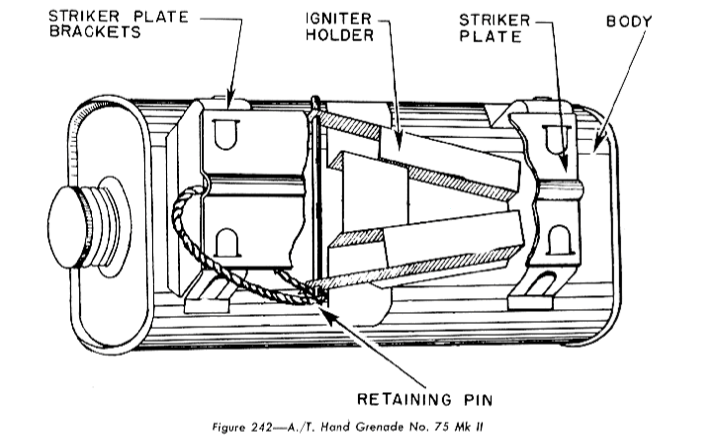
The No. 75 Hawkins grenade, officially Grenade, Hand, Anti-Tank No. 75, was a British anti-tank device usable either as a hand-thrown grenade or, more commonly, laid on a road surface as an improvised anti-tank mine. It was developed after Dunkirk, when Britain's anti-tank gun stocks were critically low, and entered service in 1942 as a more versatile successor to the No. 73 grenade and the 'sticky bomb'. A vehicle's weight crushed a plate that cracked a chemical igniter, detonating a charge of ammonal or TNT; it was most effective against tank tracks, and several laid together could disable a medium tank. It saw use by British, Commonwealth, and US forces in the Mediterranean and North-West Europe campaigns, and its design was adapted by the United States as the M7 anti-tank mine.
| weight | 1.02 kg (2.2 lb) |
|---|---|
| charge | 0.45 kg ammonal or TNT |
| dimensions | 150 mm x 75 mm |
| fuze | crush-actuated chemical igniter |
| produced | unknown |
Western Europe, Mediterranean and North Africa