Western Europe · United States vs Germany
Battle of Huertgen Forest
19 September 1944 – 16 December 1944
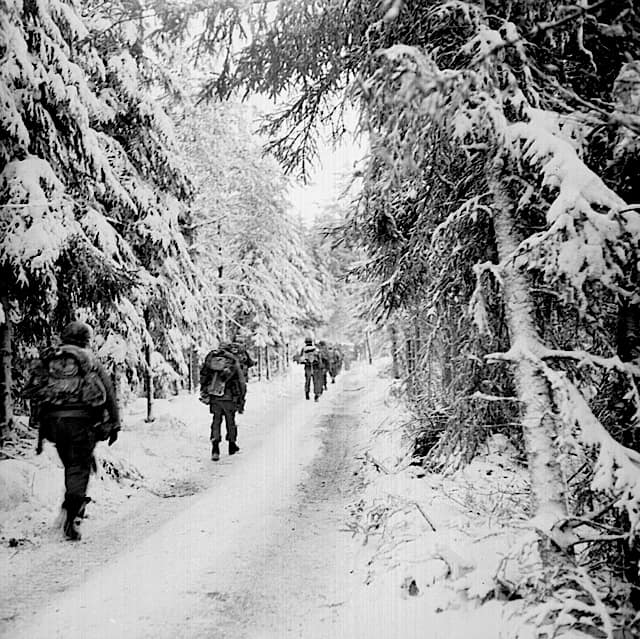
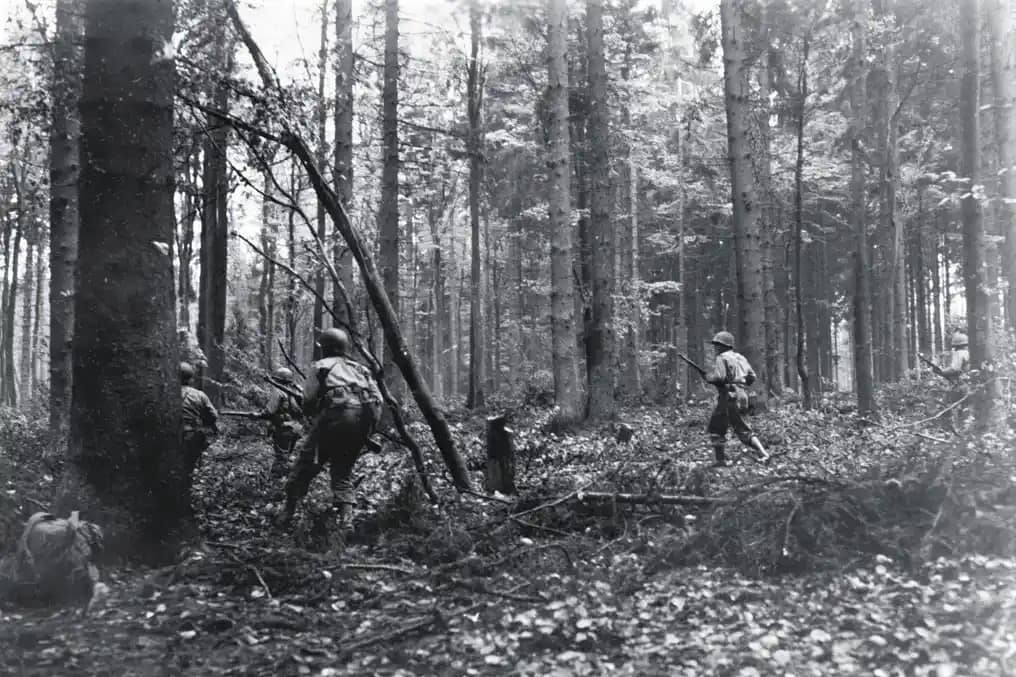
The US First Army fought for three months through the dense forest south-east of Aachen, in terrain that nullified armour and air power. Aachen itself fell on 21 October, the first German city taken. The forest cost around 33,000 American casualties and the Roer dams remained in German hands when the Ardennes offensive struck.
Explore Battle of Huertgen Forest on the interactive map · Wikipedia
Day by day
— Into the forest
The 9th Infantry Division turns east off the Stolberg corridor into the Huertgenwald, a block of planted fir some fifty square miles across on the flank of the drive to the Roer. Under the trees shells burst overhead, tanks cannot leave the firebreaks and aircraft cannot see the ground.
— Aachen
After nine days of street fighting, Colonel Wilck surrenders what is left of the garrison at 12:05: Aachen is the first German city to fall. In the forest to the south-east the 9th Division has taken 4,500 casualties for three kilometres of trees.
— Schmidt
The 28th Division attacks across the Kall gorge and takes Schmidt on the 3rd. Counter-attacks by the 116th Panzer throw the regiment off the ridge the next morning, and the tanks sent to help cannot get down the Kall trail. In a fortnight the division loses 6,184 men.
— Operation Queen
The heaviest air bombardment yet flown in direct support of ground troops opens the drive to the Roer: some 4,500 aircraft on Eschweiler, Langerwehe, Duren and Julich. The 4th and 8th Divisions grind on through Huertgen and Grosshau at a few hundred metres a day.
— The dams still stand
The offensive stops when the German attack opens in the Ardennes forty kilometres to the south. The Rangers have Hill 400 above Bergstein, but the Roer dams, which the Germans can open to drown any crossing downstream, are still theirs. Three months in the forest have cost the First Army some 33,000 men.
.jpg)

.jpg)