Eastern Front · Germany vs Soviet Union
Battle of Smolensk
10 July 1941 – 10 September 1941
Army Group Centre encircled three Soviet armies around Smolensk but was then held for two months by repeated Soviet counterattacks. The fighting cost the Red Army over 700,000 casualties yet delayed the drive on Moscow and produced the first Soviet offensive success at Yelnya.
Explore Battle of Smolensk on the interactive map · Wikipedia
Day by day
— Over the Dnieper
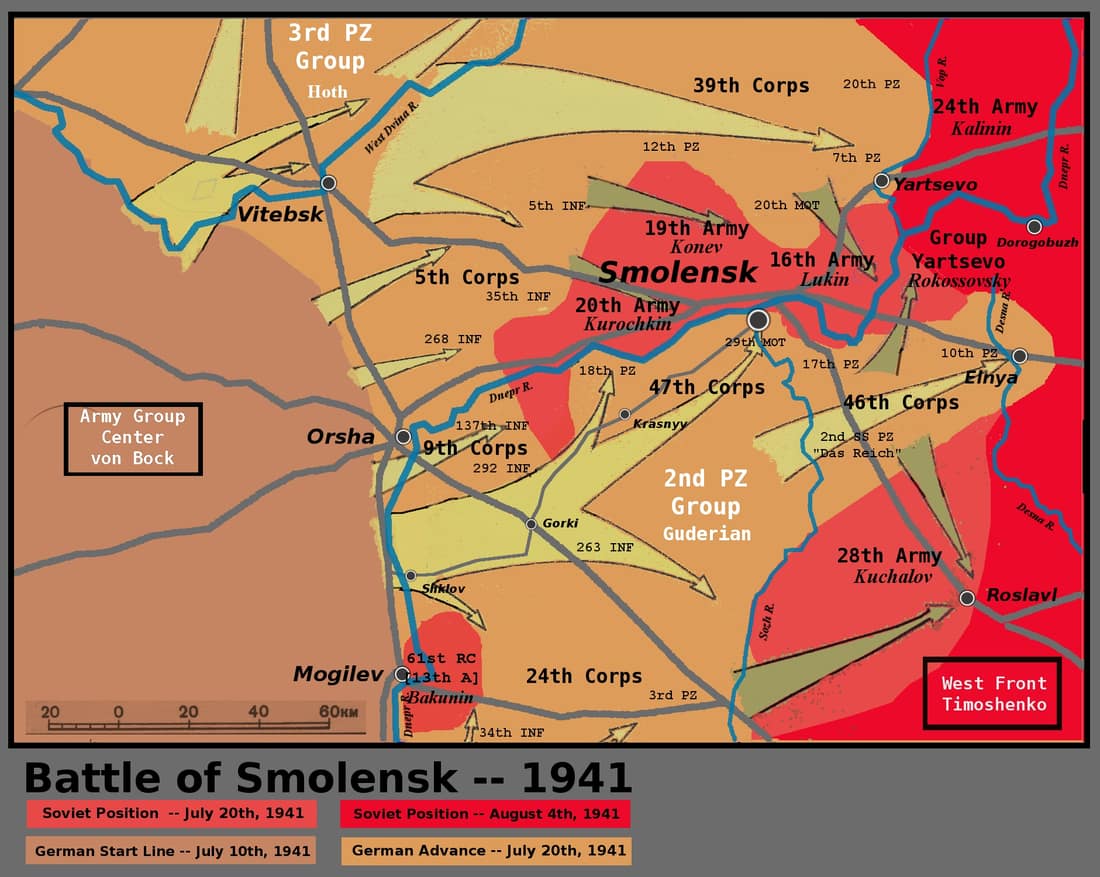
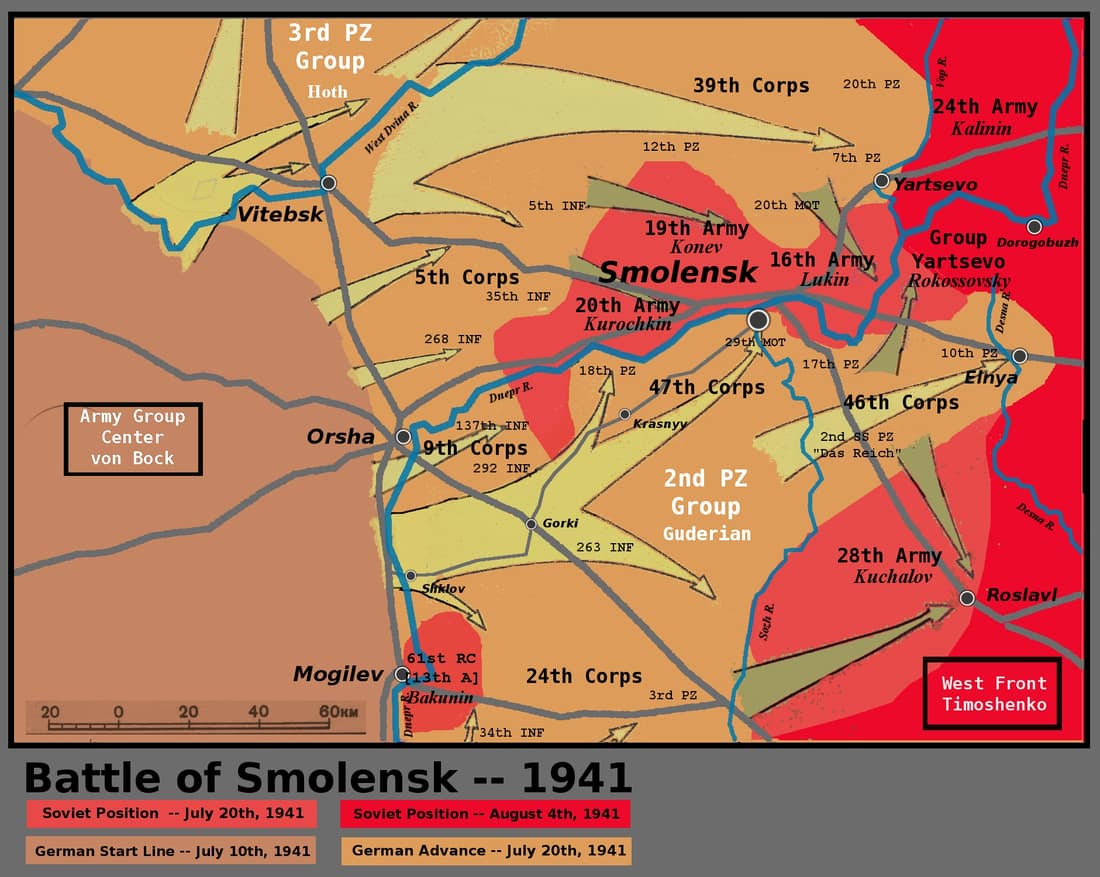
Guderian crosses the Dnieper at three places above and below Mogilev without waiting for the infantry, and Hoth comes round the north from Vitebsk. Timoshenko has five armies on the line, most of them scraped together from the interior and only half arrived. The two panzer groups are aiming to meet 200 kilometres behind them, east of Smolensk.
— Smolensk
The 29th Motorised Division is in Smolensk on the evening of the 16th, 700 kilometres from the frontier in three and a half weeks. The 16th and 20th Armies are cut off west and north of the city, but the ring is not shut: a ferry at Solovyovo on the Dnieper stays open and men and guns come out of it every night. Mogilev holds on behind the front until the 26th.
— The pocket closed
The 7th and 17th Panzer Divisions finally shut the crossings on 27 July. About 300,000 prisoners are counted over the following week, along with 3,200 tanks for the battle as a whole. But Timoshenko is already attacking the outside of the ring with five improvised army groups, and Army Group Centre spends August fighting where it stands rather than driving on.
— Yelnya
The Germans had pushed a salient over the Desna at Yelnya in July and held it against everything sent at it for six weeks. Zhukov attacks it again on 30 August with the Reserve Front, this time with 800 guns and a fortnight of registered fire. It is the first properly prepared Soviet attack of the war.
— Yelnya retaken
The Germans pull out of the salient on the night of 5 September and the 100th and 127th Rifle Divisions walk into Yelnya on the 6th: the first town taken back from the Wehrmacht. The four divisions that made the attack become the Red Army's first Guards divisions on 18 September. The ground cost about 30,000 Soviet casualties.
— Onto the defensive
Stavka stops the attacks on 10 September and tells the Western Front to dig. Two months of fighting have cost the Red Army over 700,000 men, and Army Group Centre a quarter of a million: the first time it has been held anywhere. The three weeks it lost here are the three weeks it does not have in front of Moscow in December.