Mediterranean and North Africa · Germany and Italy vs British Commonwealth
Rommel's first offensive
24 March 1941 – 15 April 1941
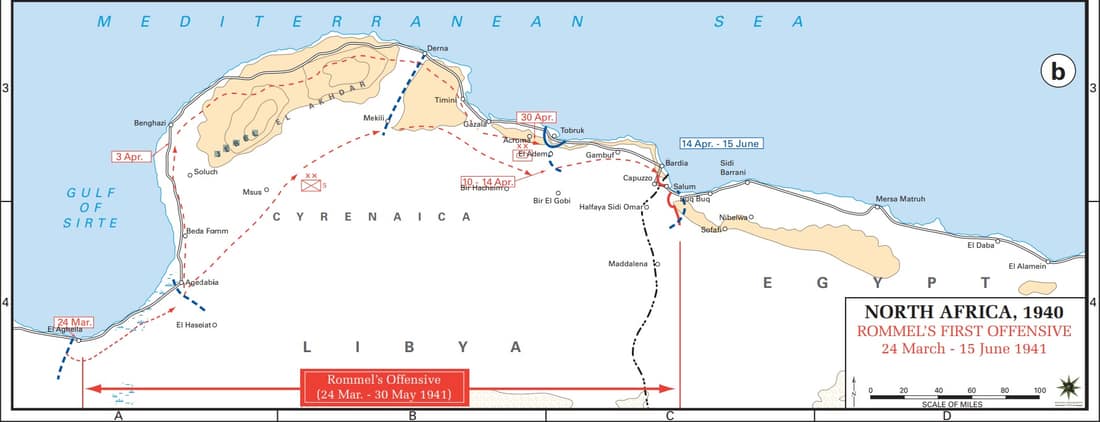
Weeks after landing in Tripoli, Rommel attacked the thinned-out British forces in Cyrenaica against orders. In three weeks he retook Benghazi, captured O'Connor, invested Tobruk and reached the Egyptian frontier.
Explore Rommel's first offensive on the interactive map · Wikipedia
Day by day
— El Agheila
Rommel landed at Tripoli on 12 February with orders to hold the line and wait for his second division. In front of him the 2nd Armoured Division had 23 worn cruiser tanks and the 9th Australian was two brigades short, both of them replacements for the veterans sent to Greece. On 24 March a reconnaissance battalion pushed the British outposts out of El Agheila, and found nothing behind them.
— Benghazi
Mersa Brega fell on 31 March and Agedabia on 2 April, and Rommel then split his force into three columns and drove them across the Jebel at once, against his orders and against the advice of the Italian command. The 9th Australian was told to leave Benghazi on the 3rd; German troops entered it on the evening of the 4th. The 2nd Armoured broke down for want of fuel and spares somewhere between Antelat and Msus.
— Two generals
Neame and O'Connor, driving back along the Derna road at night, took a wrong turning and were captured by a German patrol near Martuba on the night of the 6th. At Mechili the 3rd Indian Motor Brigade was surrounded and broken up on the 8th after two attempts to fight its way out. The 9th Australian withdrew along the coast to Tobruk, which it reached on the 9th.
— Tobruk invested
By Good Friday the fortress was cut off by land, and the German columns went on past it towards the frontier. Morshead had four Australian brigades and British gunners inside a perimeter of 50 kilometres, with a harbour that the Navy could still reach. Rommel's attacks on the 11th, the 14th and the 30th all broke on it.
— The frontier
Bardia, Sollum and the Halfaya Pass were taken in the middle of the month and the Axis line came to rest on the Egyptian frontier, 800 kilometres from where it had started three weeks earlier. Everything Compass had won was gone except Tobruk, which sat across the coast road behind the front and had to be supplied by sea from Alexandria. Rommel's own supplies now came up that same road, 1,500 kilometres from Tripoli.