Eastern Front · Soviet Union and Mongolia vs Japan
Soviet Invasion of Manchuria
9 August 1945 – 20 August 1945
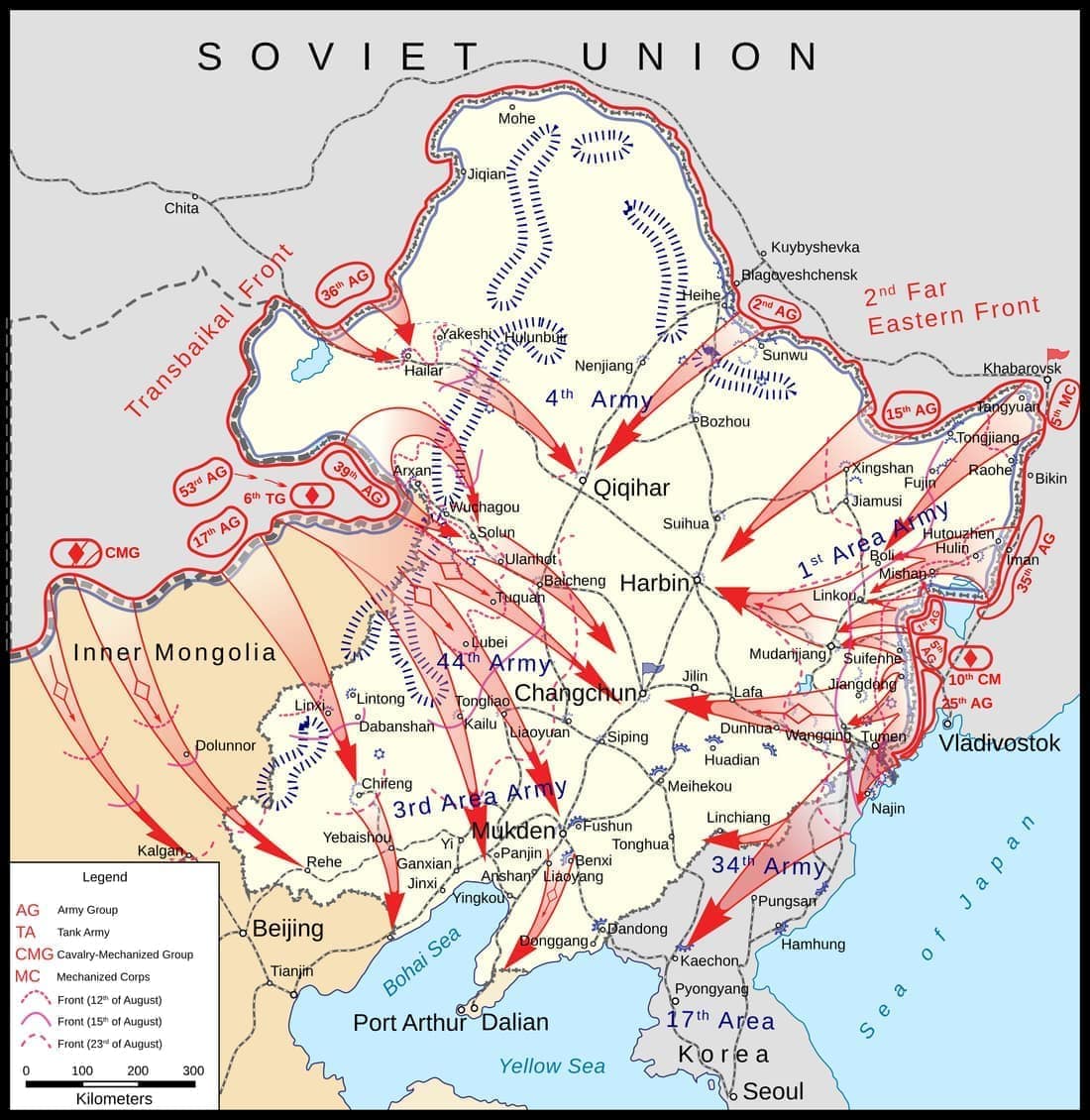
Three Soviet fronts with 1.5 million men attacked the Japanese Kwantung Army from three directions across Manchuria, including a tank army advancing over the Greater Khingan mountains from Mongolia. The Japanese army collapsed in under two weeks, and the Soviets occupied Manchuria, northern Korea, southern Sakhalin and the Kurils.
Explore Soviet Invasion of Manchuria on the interactive map · Wikipedia
Day by day
— Three fronts at once
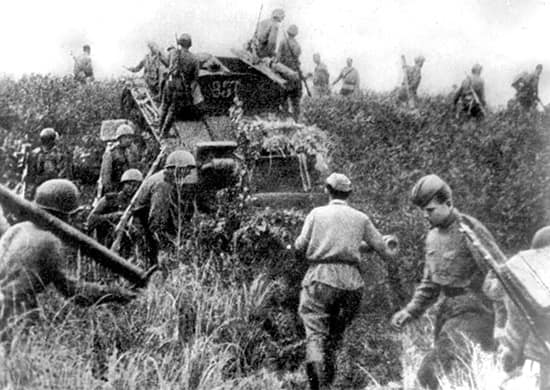
Ten minutes past midnight Trans-Baikal time, 1.5 million men cross the Manchurian border from Mongolia in the west, over the Amur in the north and out of the Maritime Province in the east, in heavy rain and without an opening bombardment. The Kwantung Army has been stripped for the Pacific and has about 700,000 men, most of them second-line, with no tanks worth the name and almost no fuel. Nagasaki is bombed the same morning.
— Over the Khingan
The 6th Guards Tank Army climbs the Greater Khingan on tracks and comes down onto the Manchurian plain on the fourth day, 450 kilometres in, with its fuel flown to it. The Japanese had thought the range impassable to armour and had left it almost undefended. In the east the fighting at Mudanjiang is the hardest of the campaign.
— The broadcast
The Emperor's recording is played at noon Tokyo time, but Kwantung Army headquarters at Changchun sends out no general ceasefire and the fighting goes on for days. Mudanjiang falls on the 16th after four days of house-to-house fighting. The Transbaikal Front is closing on Changchun and Mukden from the west.
— Surrender ordered
Yamada is finally given imperial authority and orders the Kwantung Army to lay down its arms on the 17th; word reaches units over the following days, and some garrisons in the border fortifications fight on into September. On the 18th Soviet troops land on Shumshu at the northern end of the Kurils, the only landing of the campaign to meet a real defence.
— The cities
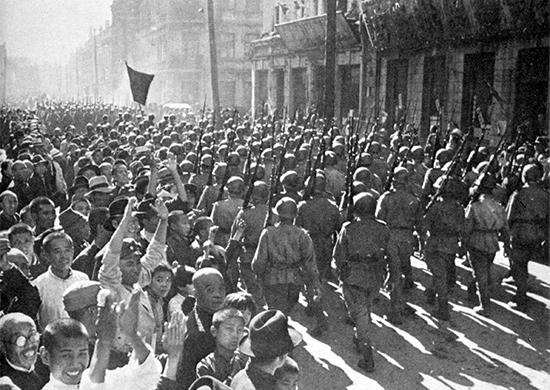
Small airborne parties fly in ahead of the tanks and take the surrender at Harbin, Changchun, Mukden and Port Arthur; at Mukden they find the Manchukuo emperor Puyi waiting for an aeroplane to Japan. Organised resistance is over on the 20th. About 600,000 Japanese and Manchukuoan troops go into Soviet captivity, and most of them are sent to Siberia.