Pacific · United States and Australia vs Japan
Battle of the Bismarck Sea
28 February 1943 – 4 March 1943
A Japanese convoy of eight destroyers and eight transports carrying reinforcements to Lae in New Guinea was found and destroyed by land-based Allied bombers using new low-level skip-bombing tactics. All the transports and half the destroyers were sunk and some 3,000 troops died, most of them in the water. The disaster ended Japan's ability to reinforce New Guinea by sea in daylight and shaped the rest of the campaign.
Explore Battle of the Bismarck Sea on the interactive map · Wikipedia
Day by day
— The convoy sails
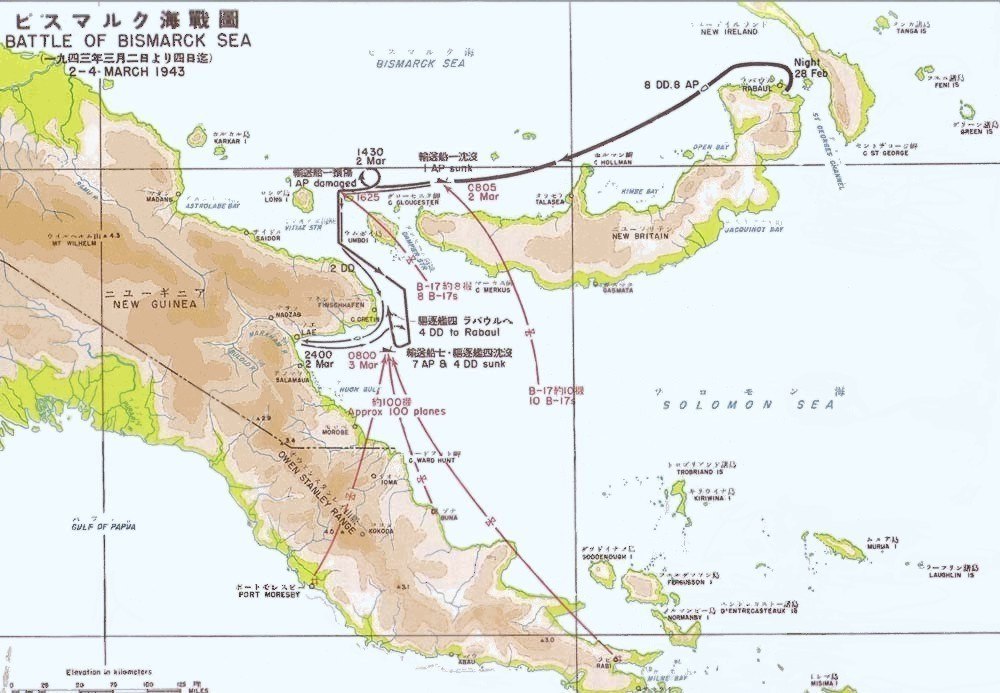
Eight transports and eight destroyers leave Rabaul at midnight carrying most of the 51st Division to Lae. The plan is to run west along the north coast of New Britain under cloud, turn through the Vitiaz Strait and unload in two nights. Allied codebreaking has known the sailing date for a fortnight.
— The B-17s find it
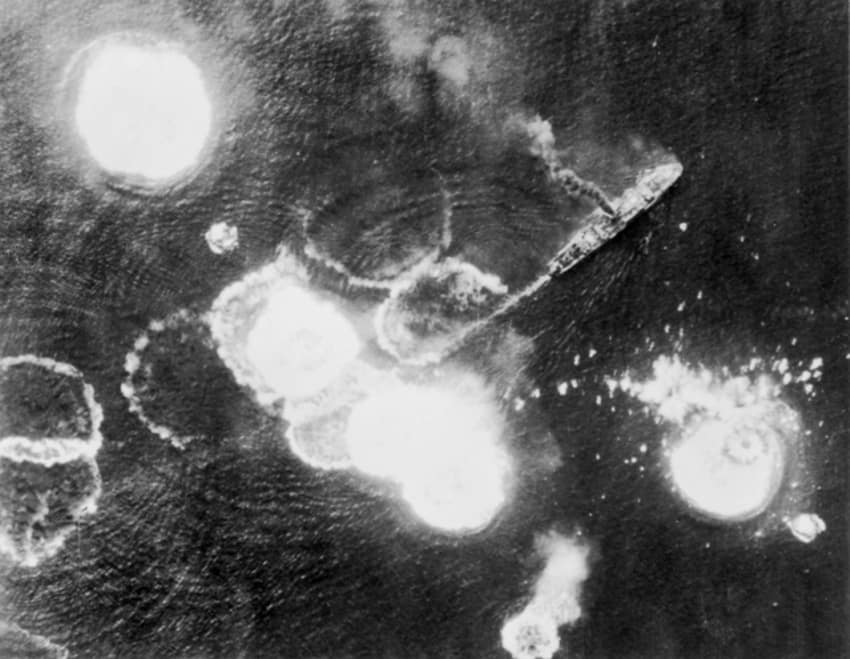
A Liberator sights the convoy on the afternoon of 1 March; heavy weather hides it again until the morning of the 2nd. B-17s of the 43rd Bombardment Group attack from 5,000 feet through the day and sink the transport Kyokusei Maru with 1,200 men aboard. Two destroyers take off her survivors and run ahead to Lae.
— Mast height
The convoy is through the strait and in the Huon Gulf by first light. From 10:00 a co-ordinated attack goes in: Beaufighters of No. 30 Squadron RAAF strafe the length of the ships while B-25s of the 3rd and 38th Bombardment Groups skip 500-pound bombs into their sides from fifty feet. By dark every transport and four destroyers are sinking or gone.
— The hunt
The four surviving destroyers are away to Rabaul with what survivors they could lift. PT boats out of Tufi and aircraft spend the day among the wreckage and the rafts. Of about 6,900 men embarked, some 1,200 reach Lae and around 3,000 die; Japan does not try to reinforce New Guinea by daylight convoy again.
.jpg)
_-_NARA_-_292571.jpg)