2194days

Western Europe · United Kingdom and United States vs Germany

Bombing of Dresden

13 February 1945 – 15 February 1945

Two RAF night raids and two USAAF day raids struck Dresden, crowded with refugees from the east. The second RAF wave arrived as the first fires merged into a firestorm that destroyed the old city. Up to 25,000 people were killed; the raid became the most debated of the bombing war.

Explore Bombing of Dresden on the interactive map · Wikipedia

Day by day

— Two waves

The Russians are on the Oder and Dresden, an unbombed city of baroque stone crowded with refugees from Silesia, is put on the target list as a communications centre behind the eastern front. 244 Lancasters mark and bomb at 22:13; three hours later, when the fire services of the whole region have converged on the burning old city, 529 more arrive on the light of the fires. The two waves make a firestorm across some twenty square kilometres.

— The old city gone

By morning the Altstadt inside the ring road is burnt out, from the Zwinger and the Frauenkirche across to Johannstadt; the church stands until the stone gives way and falls the next day. At noon 316 Fortresses of the Eighth Air Force bomb the Friedrichstadt marshalling yards through the smoke by radar, and their escorting fighters strafe the roads. About 25,000 people are killed over the two days.

— The last raid

211 Fortresses briefed for the synthetic oil plant at Boehlen find it under cloud and bomb Dresden instead, their secondary target. The city burns for days and the bodies are cremated on grids of steel girders in the Altmarkt. Dresden becomes the most argued-over raid of the bombing war, and the argument has never settled.
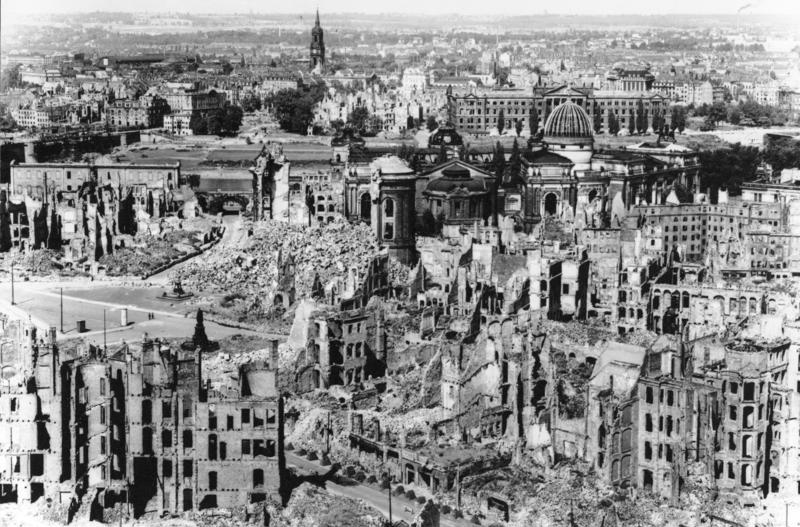
For documentary purposes the German Federal Archive often retained the original image captions, which may be erroneous, biased, obsolete or politically extreme. Dresden, Teilansicht des zerstörten Stadtzentrums über die
For documentary purposes the German Federal Archive often retained the original image captions, which may be erroneous, biased, obsolete or politically extreme. Dresden, Teilansicht des zerstörten Stadtzentrums über die Unknown authorUnknown author · CC BY-SA 3.0 de · source
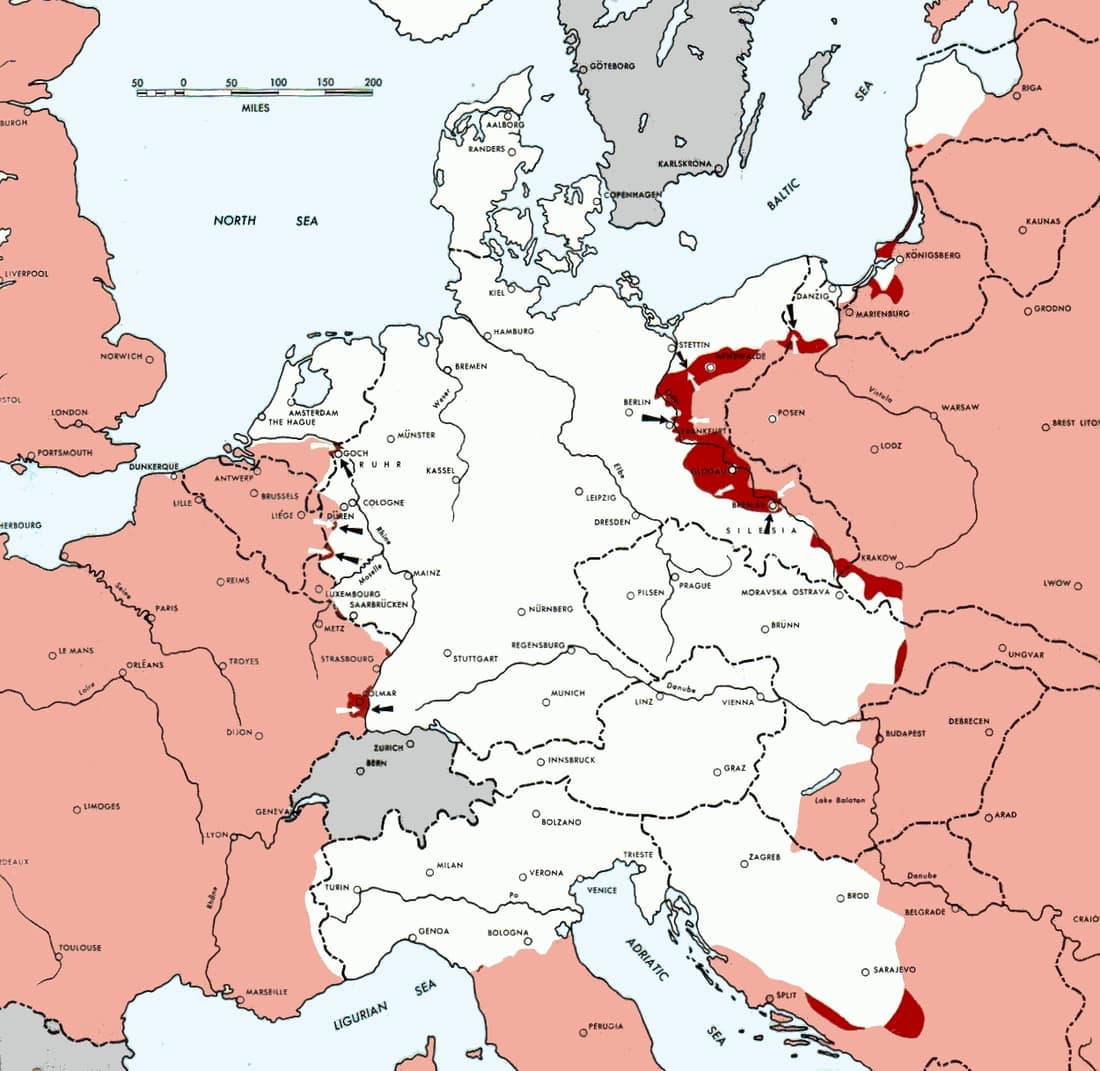
Map of the front against Germany: This map is taken from the source "Atlas of the World Battle Fronts in Semimonthly Phases to August 15th 1945: Supplement to The Biennial report of The Chief of Staff of the United State
Map of the front against Germany: This map is taken from the source "Atlas of the World Battle Fronts in Semimonthly Phases to August 15th 1945: Supplement to The Biennial report of The Chief of Staff of the United StateArmy Map Service · Public domain · source
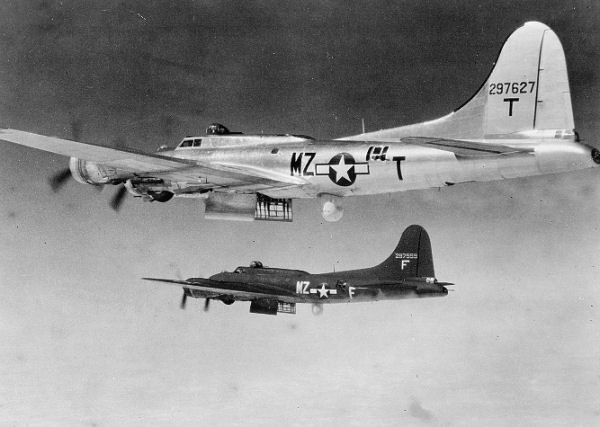
In foreground is Lockheed/Vega B-17G-20-VE Flying Fortresss Serial 42-97627, of the 413th Bomb Squadron, 96th Bomb Group, based at RAF Snetterton Heath, England.
In foreground is Lockheed/Vega B-17G-20-VE Flying Fortresss Serial 42-97627, of the 413th Bomb Squadron, 96th Bomb Group, based at RAF Snetterton Heath, England.assumed USAAF · Public domain · source
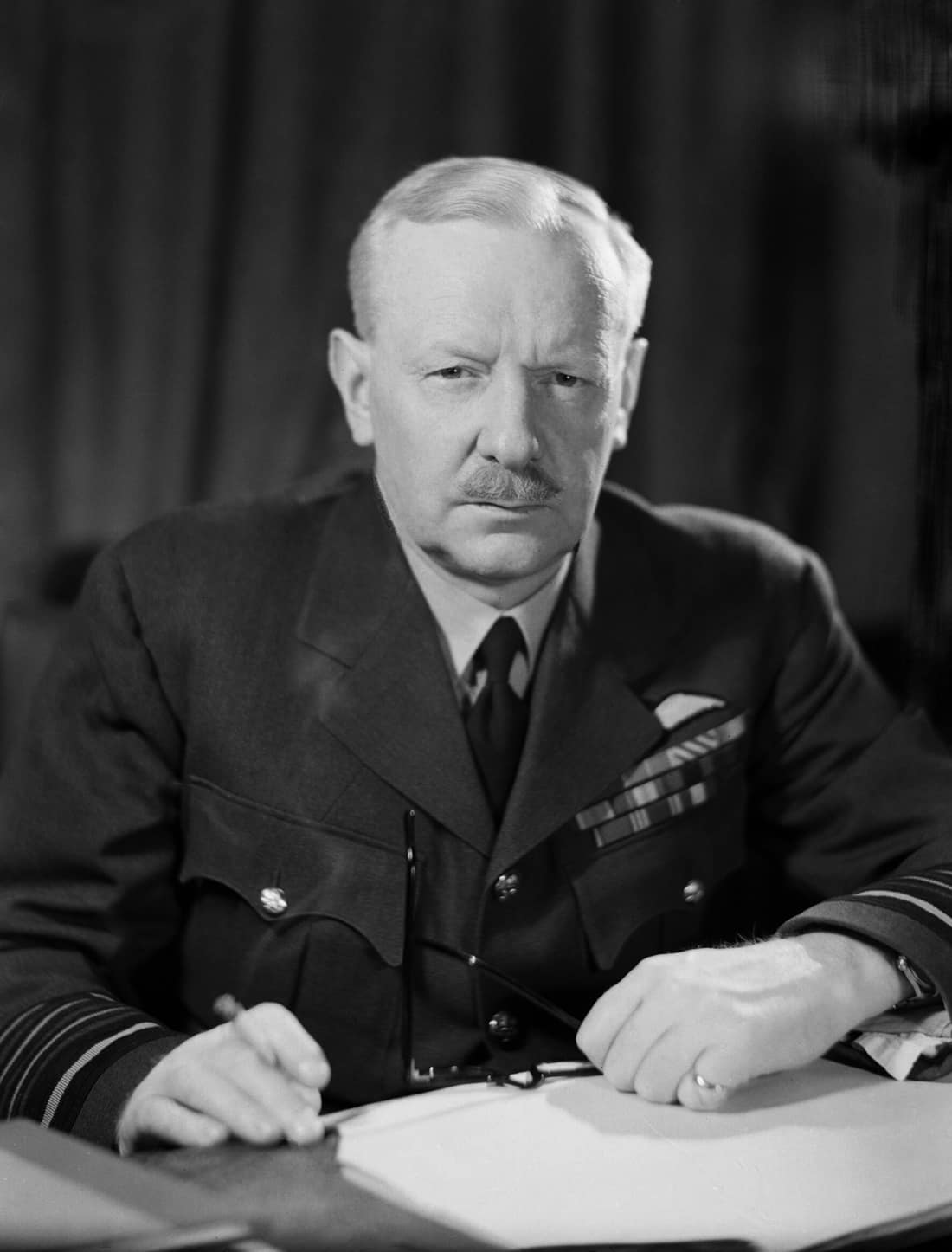
Air Chief Marshal Sir Arthur Harris, Commander in Chief of Royal Air Force Bomber Command, seated at his desk at Bomber Command HQ, High Wycombe.
Air Chief Marshal Sir Arthur Harris, Commander in Chief of Royal Air Force Bomber Command, seated at his desk at Bomber Command HQ, High Wycombe.Fg Off Stannus, Royal Air Force official photographer · Public domain · source

Equipment in this battle

Also in Western Europe