Mediterranean and North Africa · United States, Britain and Canada vs Germany and Italy
Allied invasion of Sicily
9 July 1943 – 17 August 1943
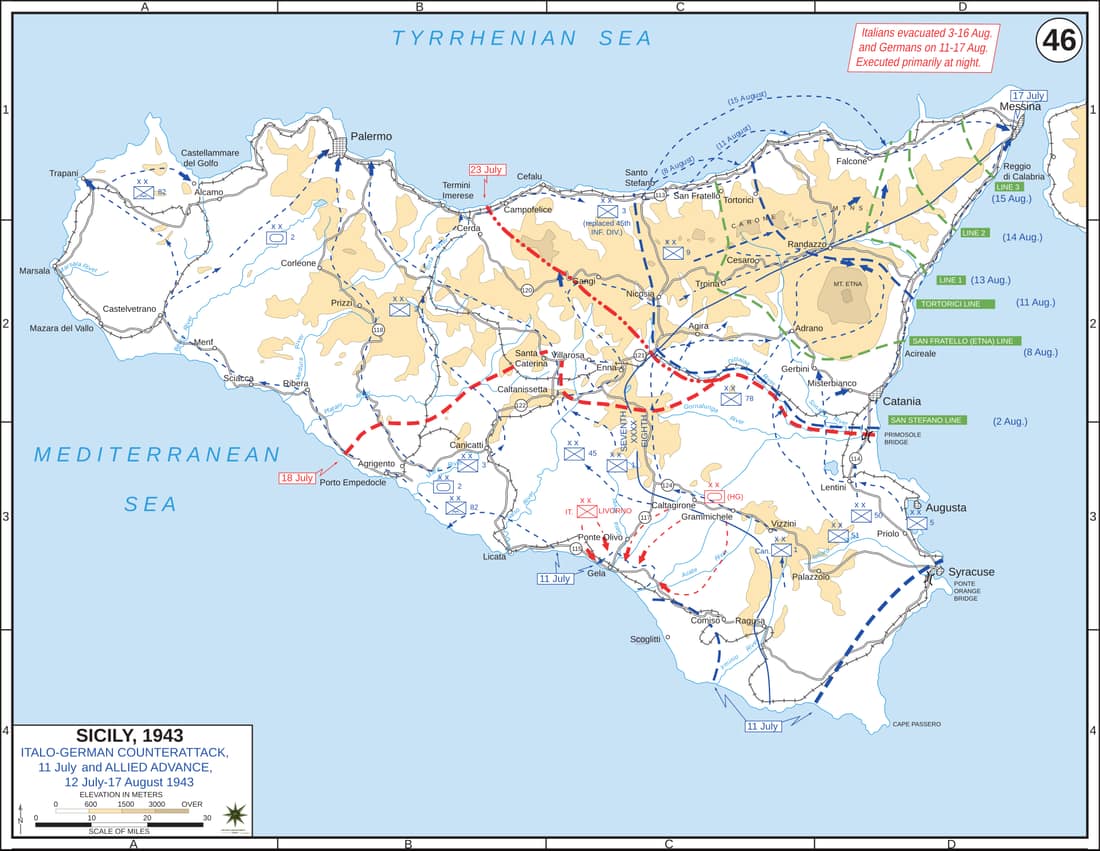
The largest amphibious operation to that date put the Seventh and Eighth Armies ashore on the south-east coast. Sicily was cleared in 38 days, but the Germans evacuated most of their force across the Strait of Messina. The invasion precipitated Mussolini's fall.
Explore Allied invasion of Sicily on the interactive map · Wikipedia
Day by day
— The airborne night
A gale gets up in the afternoon and the airborne plan comes apart in it. Of 137 gliders carrying the British 1st Airlanding Brigade to the Ponte Grande south of Syracuse, 69 are released too early and come down in the sea; the American 505th Parachute Infantry is scattered over a hundred kilometres of the south-east corner. Eighty-seven men reach the Ponte Grande and hold it until morning.
— The landings
Seven divisions go ashore at 02:45 on a front of 160 kilometres, the largest amphibious assault yet made. The same gale that wrecked the air plan has flattened the Italian coastal divisions' expectation of an attack, and resistance on the beaches is slight. Syracuse and its harbour fall to the British 5th Division that evening, intact.
— Gela
The Hermann Goering Division's tanks come down the Ponte Olivo road at the American beachhead and get within 2,000 metres of the water. They are stopped by the 1st Division's artillery firing over open sights, a handful of tanks landed that morning, and the six-inch guns of the cruisers Boise and Savannah offshore. That night the reserve parachute drop is fired on by its own fleet and 23 aircraft are shot down.
— Palermo
Eighth Army's drive up the east coast has stuck on the Catania plain, where the German 1st Parachute Division dropped onto the Primosole bridge and fought the British paratroops for it. Patton, given the west of the island as a flank guard, makes a corps of two divisions and sweeps it 160 kilometres in four days through country the Italians barely defend. Palermo falls on the 22nd with 53,000 prisoners.
— The Etna line
Hube has drawn the four German divisions back onto a short line round the base of Etna and is fighting for time. Troina takes the US 1st Division six days and Agira the Canadians five; the amphibious hooks along the north coast at Brolo land behind a front that has already gone. Catania is entered on 5 August, empty.
— Messina
Operation Lehrgang runs from 11 to 17 August across a strait three kilometres wide covered by the heaviest anti-aircraft concentration of the war: 40,000 German and 62,000 Italian troops, 10,000 vehicles and 47 tanks are ferried to the mainland in six nights, almost unhindered. Patton's patrols enter Messina on the morning of the 17th, a few hours behind them. Sicily has taken 38 days and cost the Allies about 25,000 casualties.