Eastern Front · Germany vs Soviet Union
Third Battle of Kharkov
19 February 1943 – 15 March 1943
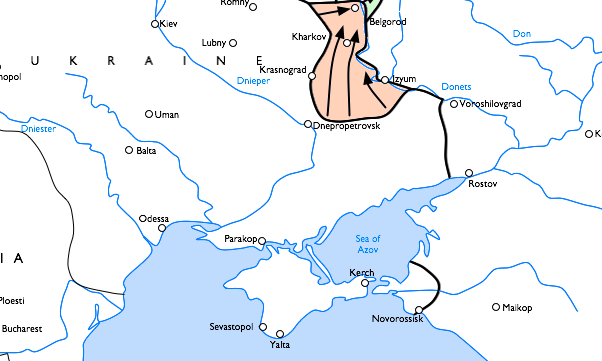
After the Soviet winter advance overran Kharkov and threatened the Dnieper crossings, Manstein's counterstroke struck the overextended Soviet spearheads. The Red Army lost Kharkov and Belgorod, and the front stabilised into the line that formed the Kursk salient.
Explore Third Battle of Kharkov on the interactive map · Wikipedia
Day by day
— The backhand blow
The Soviet winter offensive has taken Kharkov and is 150 kilometres past it, with Popov's tanks at Krasnoarmeyskoye and the 6th Army's spearheads a day from the Dnieper crossings at Zaporozhye, where Hitler met Manstein two days ago. The Soviet armies are at the end of their supply lines with a few dozen running tanks each. Today the SS Panzer Corps attacks south from Krasnograd and XL Panzer Corps north from Krasnoarmeyskoye.
— Back over the Donets
The two panzer corps met at Pavlograd on the 22nd behind the 6th Army; Popov's group was destroyed around Barvenkovo. The Southwestern Front's spearheads are back over the Donets with most of their vehicles left in the snow. Stalin and Vatutin read the German moves as a withdrawal to the Dnieper until it is too late to matter.
— On to Kharkov
Manstein turns north. Fourth Panzer Army, with the SS Panzer Corps on the Krasnograd road and Grossdeutschland on the left, attacks the 3rd Tank Army and 69th Army south-west of Kharkov; the 3rd Tank Army's two corps were caught south of Merefa on the 3rd and lost most of what remained. The thaw is two weeks off.
— Kharkov retaken
Hausser went round the west of the city on the 9th and into it from the north on the 11th, against Hoth's orders to bypass it. Three days of street fighting by the Leibstandarte and Das Reich against the 3rd Tank Army's remnants and the NKVD garrison end today. Kharkov has changed hands three times in thirteen months.
— The Kursk salient
Kharkov is fully in German hands and Belgorod falls on the 18th; then the rasputitsa stops everything. Manstein has destroyed the equivalent of six Soviet armies for the loss of a few thousand men, and the line he leaves, with a Soviet bulge round Kursk between Belgorod and Orel, is the ground of the summer.