Western Europe · Germany vs United Kingdom and Belgium
V-1 and V-2 attacks on Britain
13 June 1944 – 29 March 1945
Germany launched around 10,000 V-1 flying bombs and over 1,400 V-2 rockets at England, mainly London, and thousands more at Antwerp and Liege. Fighters, guns and balloons eventually stopped most V-1s; nothing could stop the V-2. About 8,900 British civilians were killed by the two weapons.
Explore V-1 and V-2 attacks on Britain on the interactive map · Wikipedia
Day by day
— The first flying bombs
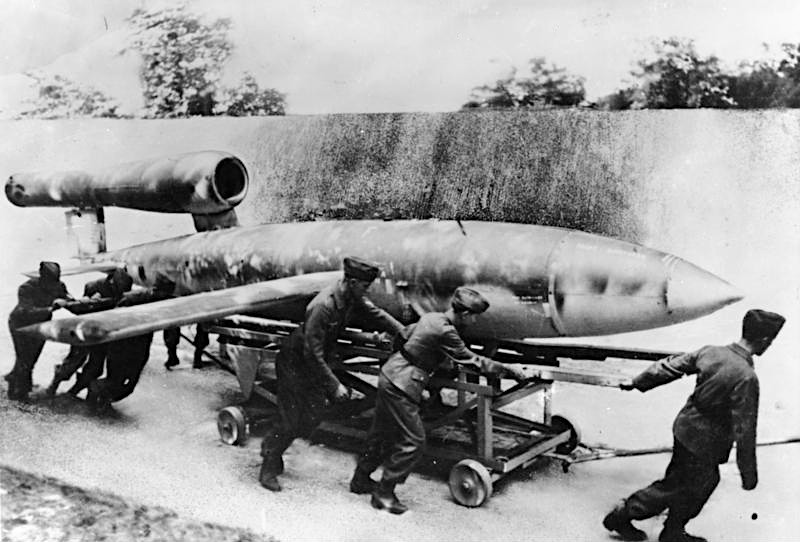
A week after D-Day, ten V-1s are launched from the Pas de Calais and four reach England; one kills six people at Grove Road in Bethnal Green. Within a fortnight a hundred a day are coming over, launched from concrete ramps hidden in the woods and orchards behind Calais and Abbeville. They fly at about 400 miles an hour at 2,500 feet, and when the engine stops the thing is already falling.
— The Guards Chapel
A V-1 comes down on the Guards Chapel at Wellington Barracks during morning service on Sunday 18 June, killing 121 people including much of the congregation of officers and their families. The defences are reorganised: the guns are moved out of London to a belt on the coast where they can shoot without dropping shells on the city, the fighters work between the coast and the guns, and the balloons stand behind.
— The rockets
The armies overrun the Pas de Calais ramps at the start of September and the flying bomb attack from France stops. On 8 September two V-2s are fired from The Hague, and one comes down at Staveley Road in Chiswick at 18:43, killing three; the government calls it a gas main for two months. The rocket climbs to eighty kilometres, arrives faster than sound and gives no warning at all, and nothing can be done about it but bomb the launch areas.
— Antwerp
Once the port of Antwerp opens it takes more V-weapons than London does: some 1,700 rockets and thousands of flying bombs fall on the city and on Liege through the winter. On 16 December a V-2 hits the Rex cinema on the Keyserlei during a full house and kills 567 people, the worst single rocket strike of the war. About 30,000 Belgians and Allied servicemen are killed or wounded in and around the two cities.
— Orpington
The last rocket to reach Britain falls on Kynaston Road in Orpington on 27 March and kills Ivy Millichamp, the last British civilian killed by enemy action in the war; the last flying bomb comes down two days later. Some 10,000 V-1s and more than 1,400 V-2s were fired at England, and about 8,900 civilians were killed by the two weapons. More people died building the rockets in the tunnels at Nordhausen than were killed by them.


.jpg)