Eastern Front · Soviet Union vs Germany, Romania, Italy and Hungary
Battle of Stalingrad
17 July 1942 – 2 February 1943
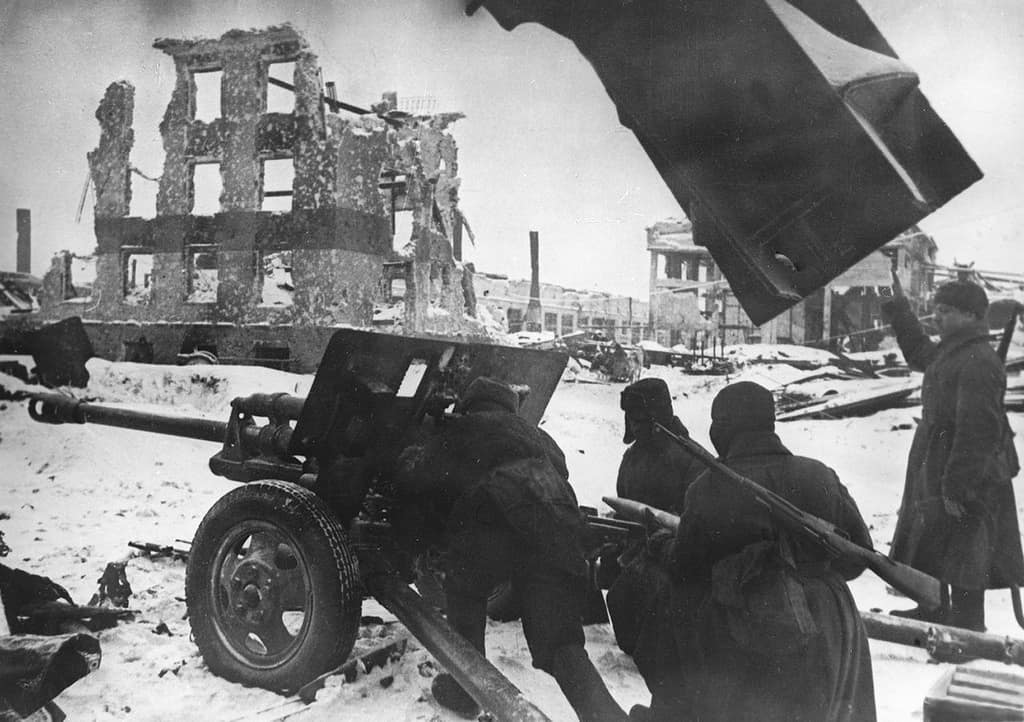
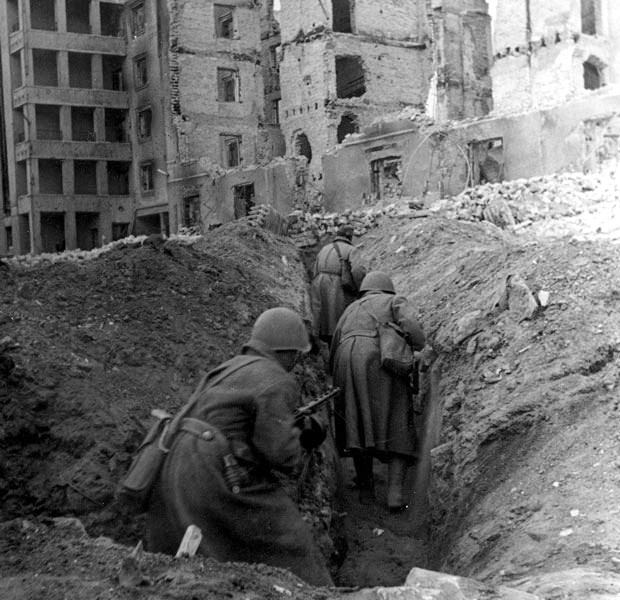
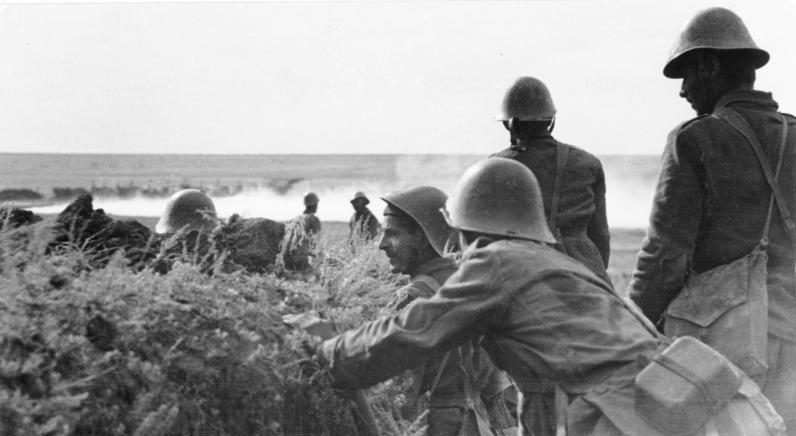
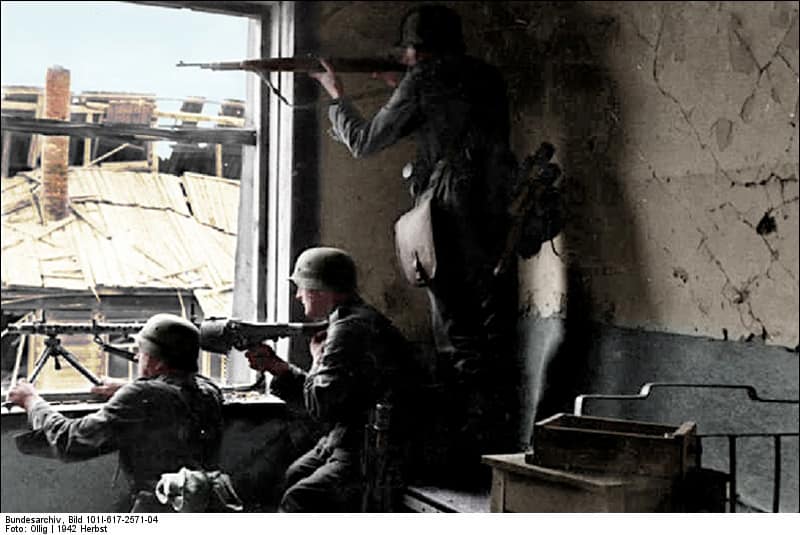
The German 6th Army fought its way into the ruins of Stalingrad through the autumn of 1942 but never cleared the Volga bank. The Soviet Operation Uranus broke the Romanian armies on the flanks and encircled some 300,000 Axis troops. A relief attempt failed and the pocket surrendered in two halves in early February 1943.
Explore Battle of Stalingrad on the interactive map · Wikipedia
Day by day
— The approach
Sixth Army's advance guard meets the new Stalingrad Front on the Chir, west of the great bend of the Don. Ahead is a hundred kilometres of steppe and then the city on the Volga.
— To the Volga
XIV Panzer Corps crosses the Don at Vertyachy and drives forty kilometres in a day to reach the Volga at Rynok, north of the city. That evening Luftflotte 4 burns Stalingrad in the heaviest raid of the eastern war.
— Into the city
Sixth Army's assault on the city itself begins. Chuikov's 62nd Army holds a strip along the west bank; the 13th Guards ferry across under fire that night to hold the central landing stage.
— The factories
The heaviest German attack of the battle takes the Tractor Factory and splits 62nd Army. The Soviets hold slivers of the bank a few hundred metres deep; the ferries run at night and the guns fire from across the Volga.
— Operation Uranus
Two Soviet fronts break through the Romanian armies guarding Sixth Army's flanks, north-west across the Don and south of the city, and drive for Kalach.
— The ring closes
The pincers meet at Sovetsky near Kalach. Some 300,000 men of Sixth Army and part of Fourth Panzer Army are inside a pocket fifty kilometres across. Hitler forbids a breakout and Goering promises to supply them by air.
— Winter Storm
Hoth's relief attack drives north-east from Kotelnikovo with three panzer divisions. It reaches the Myshkova, fifty kilometres from the pocket, and is stopped there by the 2nd Guards Army on the 23rd; Paulus does not attempt to break out to meet it.
— Operation Ring
Rokossovsky's Don Front attacks the pocket from the west with 7,000 guns. Pitomnik airfield falls on the 16th and Gumrak on the 22nd; there are no more flights out, and the survivors are pressed back into the ruins of the city.
— Paulus surrenders
Promoted field marshal the day before, Paulus surrenders in the basement of the Univermag department store. The northern pocket, around the factories, fights on for two more days. About 91,000 men go into captivity.
— The end
XI Corps in the northern pocket surrenders at noon. The Soviet guns fall silent for the first time since August.




Equipment in this battle
- 8.8 cm Flak 18/36/37/41
- DP-27 (Degtyaryov machine gun)
- Ilyushin Il-2
- Junkers Ju 52
- Junkers Ju 87
- Katyusha rocket launcher
- LaGG-3
- Lavochkin La-5
- MP 40
- Messerschmitt Bf 109
- Mosin-Nagant
- Nebelwerfer
- PM M1910
- PPSh-41
- PTRD-41
- Petlyakov Pe-2
- Polikarpov Po-2
- SVT-40
- StuG III
- T-34
- T-70
- Yakovlev Yak-1
- ZiS-3 (76mm divisional gun M1942)