Eastern Front · Soviet Union vs Germany
Battle of Kursk
5 July 1943 – 23 August 1943
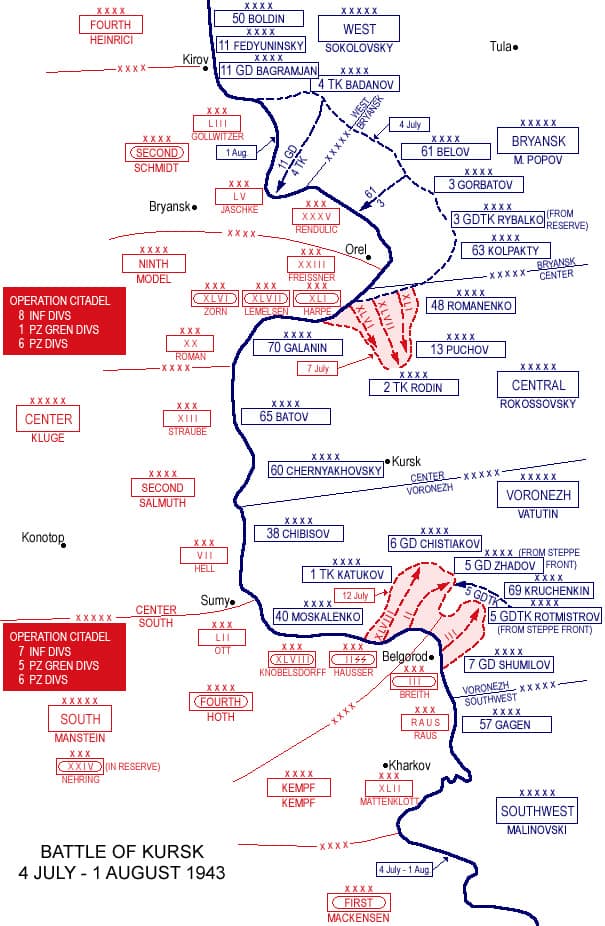
The last major German offensive in the east, Operation Citadel, attacked the Kursk salient from north and south into defences prepared over three months. It was halted within a week, and the Soviet counteroffensives Kutuzov and Rumyantsev retook Orel, Belgorod and Kharkov. The strategic initiative passed permanently to the Red Army.
Explore Battle of Kursk on the interactive map · Wikipedia
Day by day
— Citadel
After three months of waiting, Model's Ninth Army attacks the north face of the salient and Hoth's Fourth Panzer Army the south, with 2,700 tanks between them. The Soviets knew the day and the hour, and have dug eight belts of defences.
— Prokhorovka
In the north Model is stopped at Ponyri and Olkhovatka after eleven kilometres. In the south the II SS Panzer Corps meets the 5th Guards Tank Army head-on at Prokhorovka, the largest tank action of the war. The same day the Soviets open their own offensive against the Orel bulge behind Model.
— Back to the start line
Hitler called off Citadel on the 13th, with Sicily invaded and the Orel bulge collapsing. Hoth is back on his 5 July positions; Model is fighting his way out of Orel.
— Orel and Belgorod
Both cities are liberated on the same day; Moscow fires its first victory salute. Operation Rumyantsev, launched on the 3rd, has broken the German line north of Belgorod and the tank armies are running south towards Kharkov.
— Kharkov
Kharkov changes hands for the fourth and last time. The summer offensive Germany planned as its last on the eastern front has ended with the Soviets attacking everywhere from Smolensk to the Black Sea.
.jpg)